subagent-fleet: Local AI Compute Control Plane for Coding Agents
— ai, agents, open-source, local-llms — 8 min read
I built subagent-fleet because my local AI setup had outgrown the single-endpoint mental model. One laptop, one Mac mini, one workstation, and a few Ollama models should behave like a coordinated fleet, not a pile of disconnected machines.
TL;DR: subagent-fleet is an open-source control plane for running Claude Code-style subagents across local Ollama nodes. It generates LiteLLM config, Claude agent definitions, local environment files, model warmup flows, and a live SSE dashboard from one fleet.yaml.
Local LLM development has a strange ceiling. You can have plenty of useful hardware around you: a MacBook for fast planning, a Mac mini with more memory for coding, maybe a GPU workstation for heavier jobs. But most coding-agent setups still ask for one model endpoint.
That is fine for a single chat. It breaks down when you start using subagents.
A planner does not need the same model as an implementer. A reviewer should probably run on a stronger coding model. A summarizer can be cheap and local. A long-running coding session should not silently fail because one Ollama node dropped off the network.
So I built subagent-fleet: a local AI compute control plane for Claude Code-style subagents and coding agents. It sits in the same direction as my broader agent-infrastructure work, including awesome-agentic-memory and embenx: less hidden glue, more explicit runtime behavior.
The project is open source on GitHub:
github.com/adityak74/subagent-fleet
The docs site is here:
adityak74.github.io/subagent-fleet
The Core Idea
subagent-fleet sits above Ollama and LiteLLM. It does not replace either of them. Instead, it gives you one declarative fleet.yaml that describes:
- which machines are in your fleet
- which Ollama models live on each machine
- which coding-agent roles should use which models
- what Claude Code-style agent files should be generated
- how the LiteLLM gateway should route requests
The routing model is intentionally practical:
planner     -> small fast model on a lightweight node
implementer -> larger coding model on a bigger node
reviewer    -> larger coding model on a bigger node
summarizer  -> small local model on the controller
That is the whole point. Agent roles are not interchangeable. Their compute should not be either.
Why I Wanted This
My local AI projects kept converging on the same problem: I had more than one useful machine, but no clean way to treat them as one coding-agent backend.
For example, a local setup might look like this:
Claude Code / coding harness
        |
        v
LiteLLM gateway generated by subagent-fleet
        |
        +-- Ollama node: laptop
        +-- Ollama node: Mac mini 64GB
        +-- Ollama node: workstation
Without a control plane, the developer has to remember which model lives where, hand-write proxy config, keep agent definitions in sync, warm models manually, and debug routing by reading logs after something goes wrong.
That becomes tedious quickly.
With subagent-fleet, the topology is the source of truth. You define the fleet once, validate it, generate the runtime config, and start working.
What It Generates
Running:
subagent-fleet generate
creates the glue files that a local coding-agent workflow needs:
litellm_config.yaml
.claude/agents/planner.md
.claude/agents/implementer.md
.claude/agents/reviewer.md
.env.subagent-fleet
That means the same fleet.yaml can drive both the gateway and the assistant-facing subagent definitions.
Here is the shape of a simple model route:
models:
  heavy-coder:
    node: m4-mini-64gb
    ollama_model: qwen2.5-coder:32b
    litellm_alias: claude-sonnet-local
    context: 32768
    timeout: 600
    max_parallel: 1
And here is the kind of agent mapping it supports:
agents:
  planner:
    model: small-coder
    description: Use for planning, file discovery, task decomposition, and summarization.
    tools: [Read, Grep, Glob]

  implementer:
    model: heavy-coder
    description: Use for implementation, bug fixes, refactors, and patch creation.
    tools: [Read, Grep, Glob, Edit, MultiEdit, Bash]

  reviewer:
    model: heavy-coder
    description: Use after implementation to review diffs, tests, regressions, and maintainability.
    tools: [Read, Grep, Glob, Bash]
This is where the tool becomes useful: it turns role design into infrastructure.
The Dashboard
The part I care about most is visibility. Local model infrastructure often fails in boring ways: a node is asleep, an endpoint moved, a model is cold, a proxy route is wrong, or a request is hanging behind a loaded machine.
subagent-fleet ui opens a live dashboard at http://localhost:8080 that streams fleet state over SSE.
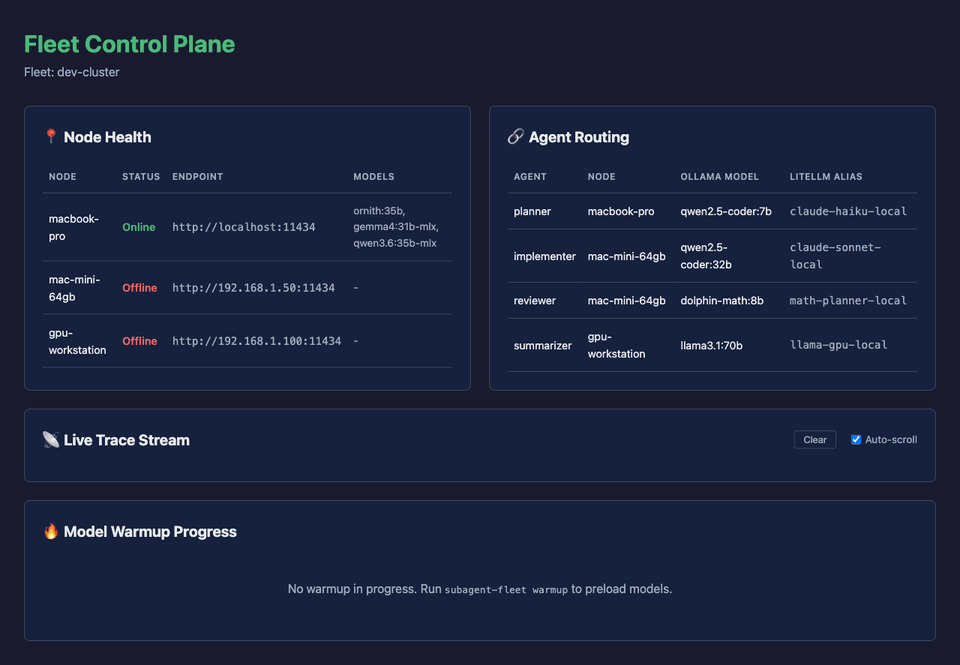
The dashboard shows:
- Node Health: which Ollama nodes are online and which models they expose
- Agent Routing: which role maps to which model and machine
- Live Trace Stream: LiteLLM logs as they happen
- Warmup Progress: model preload status before a coding session
This sounds operational, and that is the point. Once agents start doing real work, you need observability. Otherwise, you are just hoping the right local model answered.
Model Warmup Matters
One of the small but painful issues in local LLM workflows is cold startup time. The first request to a model can be slow enough to make the whole system feel unreliable.
subagent-fleet warmup preloads configured Ollama models before the session starts. The dashboard tracks warmup progress, so you can see which models are ready and which ones still need attention.
That small detail changes the feel of the workflow. Instead of waiting for the first planner or implementer call to pay the load penalty, the fleet gets prepared upfront.
The Local Fleet vs Sonnet 5 Eval
After building the control plane, the obvious question was: does this local fleet actually hold up against frontier models on coding work?
So I added a live head-to-head eval. It sends 8 real coding tasks to three systems:
- the local fleet through the LiteLLM gateway
- Claude Sonnet 5 through OpenRouter
- GPT-4o-mini through OpenRouter
The tasks are intentionally practical: bug fixes, an LRU cache, a token bucket rate limiter, N+1 query cleanup, FastAPI endpoint work, race-condition fixes, and pytest unit tests. A separate LLM judge scores each answer blind on a 0-10 rubric for correctness, code quality, and completeness.
The first run surprised me:
| System | Mean Score | Mean Latency | Total Cost |
|---|---|---|---|
| Local fleet | 8.38 | 17.47s | $0.0000 |
| Sonnet 5 | 8.88 | 5.22s | $0.0077 |
| GPT-4o-mini | 7.50 | 3.47s | $0.0004 |
The local fleet reached 94% of Sonnet 5's mean quality at $0 marginal model cost, and it beat GPT-4o-mini on mean score. It also passed 7 of 8 prompts against the bar I cared about: staying within 80% of the best frontier score for that prompt.
The one miss was useful: pytest_unit_tests. The fleet scored 4.0 there while Sonnet 5 scored 8.0. That is not a reason to hide the result. It is the kind of specific failure a good eval should surface. Local coding models can be strong at implementation and refactoring while still needing work on edge-case test generation.
The takeaway is not "local beats frontier." It does not. Sonnet 5 was faster and still had the highest mean score. The takeaway is more practical: for a large slice of coding-agent work, a well-routed local fleet can get close enough to be useful, private, and effectively free per additional run.
The full report lives in the repo at docs/evals/frontier-comparison-2026-06-30.json, and the live test can be rerun against your own fleet:
export OPENROUTER_API_KEY=<your-key>
export LITELLM_MASTER_KEY=<your-fleet-master-key>
litellm --config ./litellm_config.yaml &
python -m pytest tests/evals/test_frontier_comparison_live.py --run-live -v -s
Built for Private Local Networks
This is not a hosted SaaS control plane. It assumes your machines are on a private network: LAN, Tailscale, WireGuard, or a private subnet.
The security model is deliberately conservative:
- do not expose Ollama directly to the public internet
- do not expose LiteLLM without authentication
- keep generated environment files local
- set
LITELLM_MASTER_KEYfor gateway access
The project is meant for developers who want more control over their local AI compute, not for turning a home network into a public inference service.
The Current Release
The package version I checked locally is v0.2.1. The CLI includes:
subagent-fleet init
subagent-fleet validate
subagent-fleet discover
subagent-fleet generate
subagent-fleet warmup
subagent-fleet status
subagent-fleet doctor
subagent-fleet clean
subagent-fleet ui
subagent-fleet trace
subagent-fleet skills list
subagent-fleet skills install
subagent-fleet plugins install
Install it from PyPI:
python -m pip install subagent-fleet
Or with pipx:
pipx install subagent-fleet
Then start with:
subagent-fleet init
subagent-fleet validate
subagent-fleet discover
subagent-fleet generate
subagent-fleet ui --config fleet.yaml
Why This Is More Than a Config Generator
The deeper reason I built this is that coding agents are starting to look less like one assistant and more like a runtime.
Once you have planners, implementers, reviewers, summarizers, security checkers, documentation agents, and test generators, the question becomes: where should each role run?
The answer should depend on capability, latency, memory, availability, and cost. A fast local model is good enough for decomposition. A larger coding model is better for implementation. A separate reviewer role should have its own constraints. If a node goes offline, the system should make that obvious immediately.
That is what subagent-fleet is trying to make concrete: local agent infrastructure that is inspectable, reproducible, and role-aware.
What I Want to Explore Next
The roadmap is still evolving, but the direction is clear:
- richer routing policies for fallback and load-aware selection
- better runtime traces across multi-agent sessions
- tighter Claude Code and Codex plugin flows
- more examples for laptop-only, Mac mini, and multi-node clusters
- stronger eval coverage against real local fleets
The project already ships with examples, generated plugin artifacts, assistant skills, and a dashboard. The next step is making the control plane smarter without making it harder to operate.
Closing Thought
Local AI is not just about running one model on one machine. For serious coding-agent workflows, local AI starts to look like infrastructure.
subagent-fleet is my attempt to make that infrastructure practical: one config, one gateway, role-aware subagents, warm models, visible routing, and a dashboard that tells you what is actually happening.
If you run Ollama on more than one machine, or if you are experimenting with Claude Code-style subagents, try it: