quecto
The leanest, fastest, smallest AI harness — and the coding agent built on it.
One endpoint. Zero async. A 1.3 MB core, a 5.5 MB agent — both shipped, both statically linked, neither carrying a runtime.
Kilo is 10³. Quecto is 10⁻³⁰ — the smallest unit in the metric system. The project takes that literally: break any task down to its smallest composable piece, then compose it back up. The primitives decide nothing; every opinion is optional sugar you can bypass.
1.3 MB core, 5.5 MB agent
Both binaries are self-contained: no runtime, no interpreter, statically-linked rustls TLS. Two direct dependencies on the core (ureq + serde_json), ~30 transitive crates, no tokio, no reqwest, no async runtime. The agent adds a full tool loop, sandbox, SQLite-backed session store, and manifest parsing, and still fits in 5.5 MB.
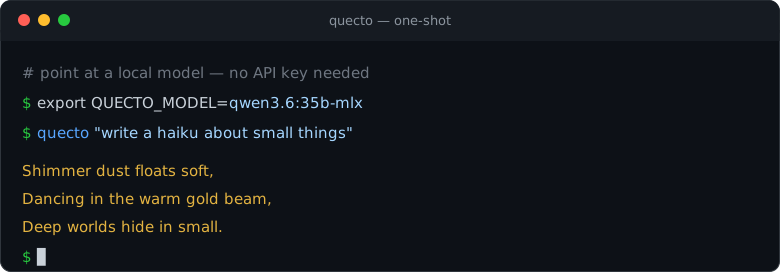
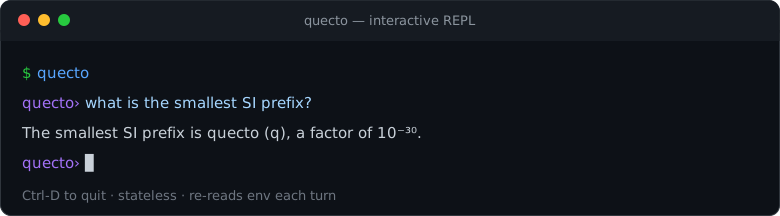
One-shot and REPL
Real output, captured live against a local qwen3.6:35b-mlx model on Ollama — no API key.
Bring your own config
Nothing in quecto is hardcoded to a vendor, a model, or a persona. Every layer is swappable via plain env vars and files, no forking required — because the core primitives shape nothing and discard nothing, none of this is a special case.
System prompt
QUECTO_SYSTEM overrides the default persona entirely — repo rules and seed context still get appended after it for quecto-agent.
Model & endpoint
QUECTO_BASE_URL + QUECTO_MODEL point at any OpenAI-compatible server: local (Ollama, LM Studio, vLLM) or cloud (OpenAI, or anything speaking the same API shape).
Behavior presets
.quecto/flavors/*.toml manifests bundle a system prompt, tool policy, and defaults into a named, trust-on-first-use profile you switch between per project.
Verification gate
QUECTO_VERIFY runs your own shell commands — tests, linters, type checks — as a post-edit gate before the agent calls a step done.
Storage locations
QUECTO_STATE_DB and QUECTO_TRUST_FILE relocate session and trust state anywhere: ephemeral, encrypted volume, shared path.
The coding agent
Built entirely on the core's quecto_raw primitive: same zero-async, statically-linked philosophy, scaled up to a full agent loop.
Tool use
File read/write/patch, search, git, and shell — multi-step tool use in a single agent loop.
Approval gating
Edits and commands gated by a configurable approval preset before anything touches disk.
Sandbox denylist
Hard-denylist blocks sudo, rm -rf /, git push, and other destructive actions even under --yes.
Verification gates
QUECTO_VERIFY runs your own tests, linters, and type checks as a post-edit gate.
Session persistence
SQLite-backed sessions power resume, undo, and diff across runs.
Flavor manifests
Named .quecto/flavors/*.toml profiles with content-hash trust-on-first-use.
Build it, run it
$ git clone https://github.com/adityak74/quecto && cd quecto
$ cargo build --release              # -> target/release/quecto (~1.3 MB)
$ cargo install --path . --force
$ quecto "write me a haiku about small things"

$ export QUECTO_BASE_URL="http://localhost:11434/v1"
$ export QUECTO_MODEL="qwen2.5-coder"
$ quecto "refactor this function"    # local, no API key

$ cargo build --release -p quecto-agent   # -> target/release/quecto-agent (~5.5 MB)
$ quecto-agent "add a test for the parse_args function"
$ quecto-agent chat
Continue through the lab
quecto is the runtime-control end of the same thesis behind subagent-fleet and embenx: small, legible, operator-controlled infrastructure.
Read the systems index
The systems page places quecto alongside subagent-fleet, embenx, and the other artifacts in the current infrastructure slice.
Read the stack
The stack page turns the thesis into a concrete systems map: runtime, memory, retrieval, simulation, tools, routing, and evaluation.