A Free Local 9B Model Optimized My Rust Agent Harness. Two of Its Three Claims Were Wrong.
— ai, agents, open-source, local-llms — 7 min read
ornith-9b — a 9B-parameter model, running entirely on my own machine, zero
API cost — opened a real performance PR against quecto,
my Rust agent harness. It wasn't a toy diff. It touched four files, changed a
hot dispatch path, and claimed three concrete wins. I asked Claude Sonnet 5
to review it the way I'd want a senior engineer to review any PR: verify every
claim against the diff, don't just skim the description. One claim was exactly
right. One was real but mislabeled. One didn't do what it said on the tin —
and got rewritten for real before merge. The result shipped as
quecto-agent v0.2.2.
This is the part of "local models are good enough now" that doesn't make it into the demo clips: good enough at writing plausible optimizations, not yet reliable at knowing whether they're true. The review step is where that gap gets caught — or doesn't.
The setup
quecto is a minimal Rust agent harness I've been building in public — the subject of an earlier post on going from a toy loop to something evaluable. It has a core library, an agent crate, a tool registry, and a trace/telemetry system, all covered by a workspace test suite.
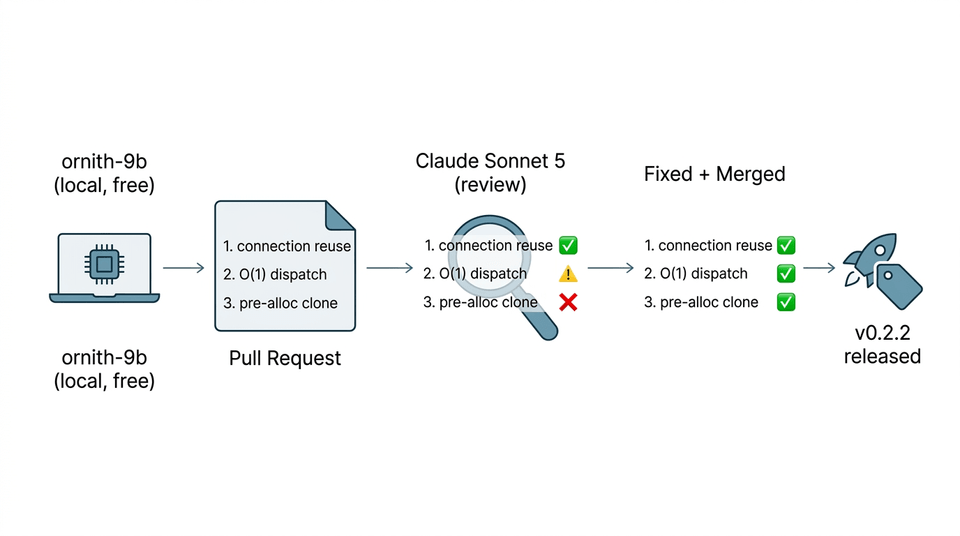
I pointed ornith-9b, running locally through a Claude Code–compatible harness, at the codebase with one instruction: find real performance opportunities and fix them. No cloud calls, no API key, no token bill. Twelve minutes later it opened PR #28: "perf: hyper-optimize quecto harness base (connection reuse, O(1) dispatch, pre-allocs)."
The PR described three changes:
- Cache the
ureq::Agent(src/lib.rs) — stop building a new HTTP connection pool on every request; share oneLazyLock<ureq::Agent>across all LLM calls. - O(1) tool dispatch (
tools/mod.rs) — replace aVec<Box<dyn Tool>>with linearfind()with aBTreeMap<String, Box<dyn Tool>>. - Pre-allocate
trace_identity(agent.rs) — clone the trace identity once per run instead of "14+ times per step."
All 24 tests in the two-crate workspace passed. On paper, it looked like a clean, mergeable perf PR — the kind of contribution that's easy to rubber-stamp if you trust the description and the green check mark.
What actually held up
I didn't take the PR description on faith. I asked Claude Sonnet 5 to check
each of the three claims against the actual diff and the workspace test
suite — not just read the bullet points and approve. Its review, posted
directly on the PR,
verified locally with cargo build --workspace and cargo test --workspace
(462 tests across the full workspace, not just the 24 in the two touched
crates) and clippy clean against pre-existing warnings only.
| Claim | Verdict | What was actually true |
|---|---|---|
Shared ureq::Agent for connection reuse | ✅ Correct | LazyLock<ureq::Agent> built once, reused via SHARED_AGENT.post(...) across every request. Description matched the diff exactly. |
"O(1) tool dispatch" via BTreeMap | ⚠️ Real, but mislabeled | BTreeMap::get is a tree lookup — O(log n), no hashing anywhere. Still a genuine improvement over the old linear scan, and the sorted iteration order is a real bonus for tool_names()/schemas() output. But it is not O(1), and at 13 registered tools the complexity class barely matters either way. |
Pre-allocated trace_identity — "eliminates 13 redundant clones per step" | ❌ Didn't do what it claimed | The diff only moved the clone source from self.trace_identity to a local run_identity variable. Every one of the ~10 emit_trace_event call sites in run_loop still deep-cloned the full TraceIdentity struct — up to 6 heap-allocated String fields — on every single call. Same allocation count as before, plus one extra clone to build run_identity. The claimed win simply wasn't there. |
Claim one was a genuinely well-executed optimization: identify a
per-request allocation, hoist it to a LazyLock, done. Claim two is the
shape of a real fix wearing the wrong name tag — BTreeMap over Vec::find()
is still strictly better, it's just not the complexity class the PR said it
was. Claim three is the one that matters: a plausible-sounding "before/after"
narrative — 14 clones per step, now 1 — that reads perfectly well in a PR
description and is simply false when you trace where the actual .clone()
calls execute.
Fixing it for real, before merge
Rather than rejecting the PR or leaving a comment and waiting, the fix for
claim three went in as a same-PR follow-up commit
(846a26a):
wrap the field in Rc<TraceIdentity>. Every run_identity.clone() at those
~10 call sites is now a refcount bump instead of a deep copy of six heap
strings, with exactly one real allocation per run_loop / run / resume
invocation — which is what the original PR description said it had already
done. Getting Rc<TraceIdentity> to serialize identically required adding
serde's rc feature so #[serde(flatten)] output on trace events didn't
change shape; the existing trace-serialization tests confirmed it didn't.
Full workspace suite after the fix: 462 passed, 0 failed. Merged same day.
quecto got a new version.
quecto-agent v0.2.2ships the connection-reuse fix and O(1)-labeled-but-actually-O(log n) tool dispatch as originally proposed — plus the trace-identity fix that only became true during review. The release notes say it plainly: "PR #28's original description overstated two of these... TheRc<TraceIdentity>fix above was implemented during review to make the clone-elimination claim actually true before merge."
Why this is the interesting result, not a knock on ornith-9b
I want to be precise about what this does and doesn't show. ornith-9b found three real hot spots in a codebase it hadn't seen before, wrote working Rust against a two-crate workspace, kept all existing tests green, and got one out of three optimizations completely right on the first try — for free, on a laptop, with no round trip to anyone's API. That's not nothing. A year ago "local 9B model opens a mergeable perf PR against a Rust workspace" would have been the whole headline.
The part worth sitting with is the failure mode on claim three, because it's not a syntax error or a broken test — those are cheap to catch. It's a narratively coherent but factually wrong performance claim: a "before: 14 clones, after: 1" story that reads as confident and specific, backed by a diff that superficially looks like it does what the story says, and passes every existing test because the tests never asserted anything about allocation count in the first place. That's exactly the class of error code review by test suite doesn't catch and code review by description doesn't catch either — it only surfaces when someone traces the actual call sites against the actual claim.
What I'm confident of:
- The connection-reuse fix (claim 1) was correct as described, verified against the diff.
- The dispatch complexity claim (claim 2) was a real improvement mislabeled with the wrong Big-O — a naming error, not a functional one.
- The trace-identity claim (claim 3) was false as originally written and is now true, because the fix was made real during review rather than accepted on description alone.
What I'm not extrapolating from one PR:
- A 1-in-3 "confidently wrong claim" rate on a single PR is a sample size of one. I'm not claiming that's ornith-9b's general hit rate, and I haven't run a matched trial against other local models on the same task to say whether this is typical or unlucky.
- This says something about this PR's claims, not about whether the underlying code changes were good ideas — two of the three were genuinely good ideas, independent of how accurately they were described.
The actual takeaway
If you're running local models through an agent harness to generate real code changes — and at 9B parameters, free, and local, there's very little reason not to try — the review step isn't optional scaffolding. It's the thing that turns "plausible diff with a confident description" into "diff that does what it says." Verify claims against the diff, not against the prose. In this case that meant the difference between shipping a trace-telemetry change that silently kept its original allocation cost and shipping one that actually eliminated it — same line count, same test result, very different truth.
Related: Building QuECTO: From Minimal Agent Harness to Evaluable Coding Agent covers the harness this PR was opened against. What Is an AI Agent Harness? covers the broader pattern of models operating inside a harness rather than freeform. subagent-fleet: Local AI Compute Control Plane covers running local models like ornith-9b as part of a coding-agent fleet in the first place.